It may surprise some of our dear viewers to know that I actually think the T’au are one of the most interesting races in WH40k, on paper. In the spirit of Tolkien, the vast majority of WH40k factions are in decline. The Drukhari, Aeldari, Imperium, Necrons, and even Chaos embody the “so much has been forgotten, never to be re-learned” epitaph. The orks never really had a civilization to lose and just sort of exist, and the tyranids occupy a spiritually similar space given they are space locusts. But the T’au? What started as a primitive xenos race 6,000 years ago is now a dominant force within the universe, technologically advanced and ideologically fascinating. Their ethos and culture is evolving and changing and that brings with it fantastic drama.
So then why am I always loathe to dive into books with the T’au? Unfortunately the T’au suffer from the same problem as Taylor Swift, the Las Vegas Golden Knights, and Rick & Morty: their fans. Now, obligatory disclaimer that not all T’au fans or authors fall into the traps I’m about to lay out, but enough do that it leaves a very sour taste in my mouth. What do they do that’s so egregious that it ruins the faction for me? They vociferously think the T’au are the “good guys” of the 40k universe. Let’s dive in.
They assimilate, not exterminate*
The biggest thing that differentiates the T’au from every other race in WH40k is that they are one of the few seemingly diplomatic races. The T’au begin most campaigns through trade and propaganda. Rabid fans will breathlessly explain that it’s because the “greater good” is an inherently peaceful ideology and that they are building toward a peaceful existence.
There is a tendency to claim this as utopic beneficence and not pragmatism. Compared to the Imperium, the T’au do not have the resources available to fight wars of attrition, so their modus operandi leans toward minimizing conflict. Keep in mind this is also an empire that is rapidly expanding its foothold across the galaxy, and comes well-armed for the occasion that planets don’t want to join. It’s really hard to paint an aggressive colonizing force as peaceful. “They just want to make life better for you,” people say. Don’t get me wrong, I like an empire that will envelop your planet into its fold under the pretense of making your lives better, but there are fans and authors who don’t seem to recognize the irony.
Also, let’s not forget the Poctroon, the first alien race the T’au attempted to assimilate that ended up all dying out to a virus to which the T’au were strangely immune. Some argue this wasn’t intentional, but the T’au wasted little time declaring the Poctroon’s home world to be a capital world.

An encroaching threat
When you don’t have a large footprint in the warp, and ergo chaos gods aren’t chomping at the bit for you, life is pretty easy in the 40k universe. This is actually part of the charm of the T’au. In many ways they are the xenos mirror to the Great Crusade, naive to the warp, expanding their empire across the stars. The consequence of their rampant colonization is the assimilation of creatures that are not immune to the warp. There is now an established presence within the warp that represents the T’au’Va, and we have established examples of T’au daemonic possession. This is riveting stuff. Even more riveting is the Fourth Sphere Expansion which is now firmly anti-assimilation of xenos races, because of their harrowing experiences in the warp.
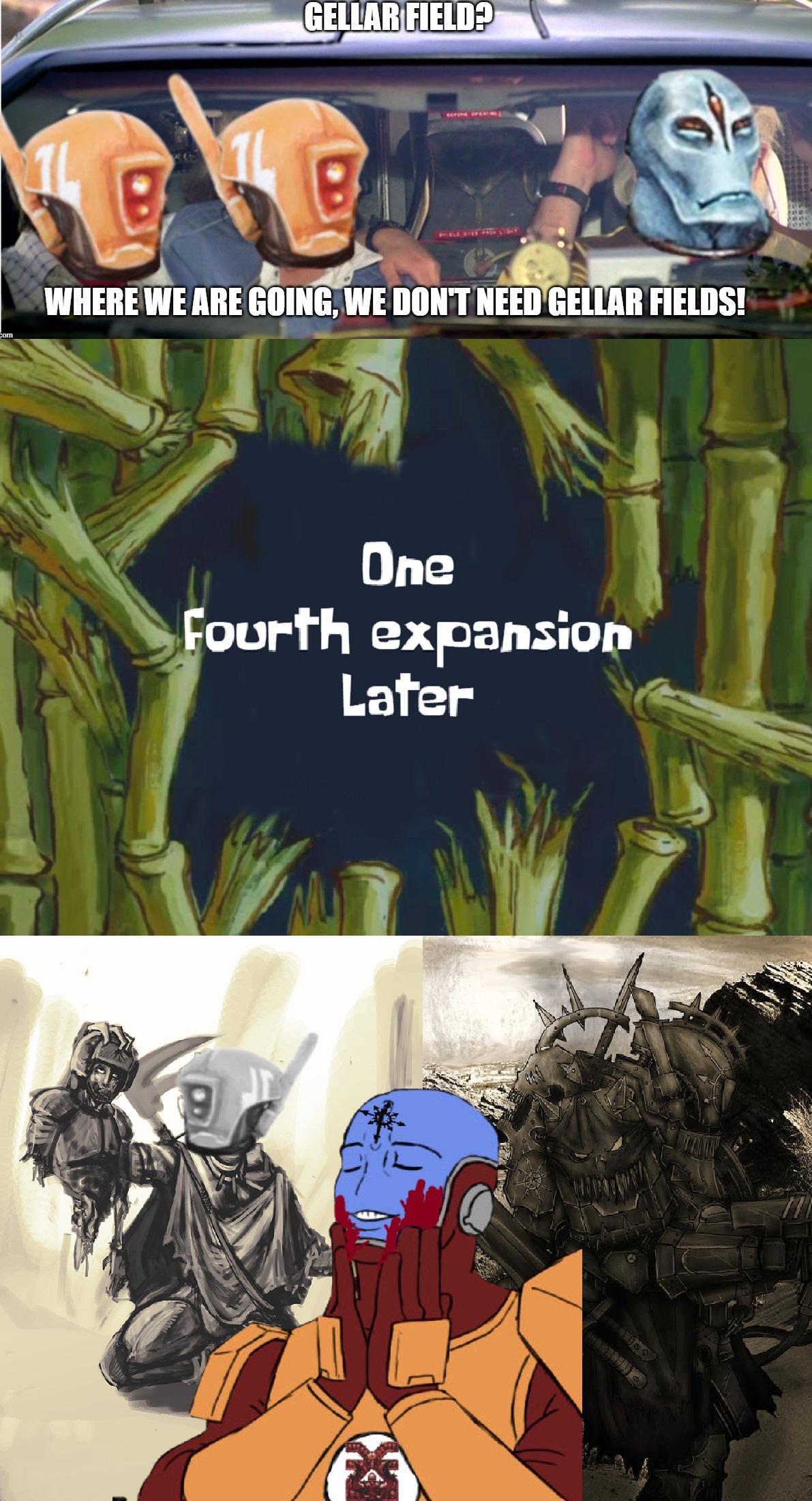
Again, it’s almost as if the T’au are a younger version of the Imperials. There is trouble in Camelot, with an unruly faction now less inclined to go along with “let’s all be (forcible) friends.” And it is also one of the major bones of contention amongst T’au fans. Phil Kelly really enjoys showing how the warp is beginning to affect the T’au, and there are a lot of fans who rail against this. How dare Phil Kelly show that a growing understanding of the nature of the Warp may cause members of the T’au to show their underlying violence and militaristic nature?
The shackled society
The biggest flaw of the T’au is their caste system. Building an orderly society upon a rigid system to which each member of the T’au is born, and can never rise above, while obeying the ruling of a small cabal, all while painting it as beneficent is a nice touch. Oh, and xenos races who join the T’au can never rise out of the non-T’au caste. You are now contributing to the greater good by working in a menial job day after day after day for faceless masters who have dictated this to be your lot in life. Hmmmm, sounds familiar, doesn’t it? Peter Fehervari tackled this head on in Fire Caste with a great conversation about whether or not T’au wish to be a different caste.
Yet stories and fan posts will breathlessly explain that this is a gross simplification or misunderstanding of T’au society. In the Imperium, you’re mining ore until you die for an uncaring war machine. In T’au society, you’re mining ore until you die for the greater good‘s war machine. The T’au, it seems, are masters of branding. It’s not a brutal fascist dictatorship; it’s collectivism toward a greater good for our people, enforced by pheromonal control to which all resistance is either futile or executed.
It’s kind of funny that some fans and authors will defend or praise the T’au system in one breath, and then praise Farsight and his collective in another. The fact that one of the most lauded T’au characters is a guy who said “nah, $#@* the oligarchy” is pretty amazing. Again, it shows a dynamic, evolving culture and mythos around a young race, which is sort of absent in the other races. The closest contemporary he has is probably Guilliman, with his fresh renewed hatred for his job.

Farsight, on paper, is fascinating, but I have yet to see him defended or used properly. Like all Important Characters™, he has plot armor in spades, which isn’t a problem per se. It’s how authors portray him, or rather his opponents. I’ve ranted about this on our podcast, but I always dislike a story that needs the antagonist to make bad decisions or behave in a dumb manner in order to make the protagonist look smart. “He’s just a brilliant commander,” fans shout. Yeah, anyone looks brilliant when your enemy is doing half your job for you.
Shades of grey
I believe that in a post-Marvel world, people enjoy the morally grey area that Warhammer 40,000 embodies. There are no strictly good guys in this universe fighting for truth and justice. It is better to think in terms of Warhammer Fantasy’s labels of “order” and “chaos.” The Imperium, Aeldari, Necrons, and T’au are violent, militaristic, uncaring factions fighting for both their survival and dominance in an orderly fashion. They’re pitted against Chaos, the Tyranids, Orks, and Drukhari who are violent, militaristic, uncaring forces fighting for dominance in a chaotic fashion. And the latter demands that the former rise to the occasion. When you’re fighting against people who find torture and murder “fun,” and whose only true joy in life is annihilating life on whatever rock they find themselves, there is no room for “goodness” or “peace.”
In the grimdark future there is only war, and the factions of order understand this intrinsically. It has taken the T’au a little while to fully understand the nature of their chaotic foes, but that is the price they pay for being relative newcomers to this unending war. It’s frustrating to see such a dynamic, complex society get misrepresented as being a wholly good, peaceful faction. More frustrating still is the vehemence with which T’au fans will shout that not loving the T’au and recognizing them as the only good faction is not only wrong, it’s stupid. They’re doing what’s good for the people they colonize! THE ETHEREALS ARE PERFECT ANGELIC BEINGS THAT ONLY WANT THE BEST FOR THEIR WORLD. FARSIGHT IS THE GREATEST MILITARY COMMANDER IN ALL OF SCIENCE FICTION.

If I wanted that type of discourse I would say that 1989 was overrated, or tell a One Piece fan that the series needed to end after two seasons. The beauty of WH40k is its dark setting, brutally flawed denizens, and morality that is a charcoal shade of grey. Screaming at people that the T’au are peaceful angels, not only kills the conversation, it makes people resistant to them. Which is actually pretty ironic, now that I think about it.


I love the T’au, but I think the lack of coherent and quality messaging has been an issue with them. I’ve tried to read some of the older novels and… they don’t really work for me for a lot of the reasons you mention. I really, really hope that Noah Van Nguyen gets to take over the reins of their future development as I absolutely *love* what he did in Elemental Council and reading through his notes and thoughts on the T’au. If you (or anyone!) hasn’t given the book a read, I cannot recommend it highly enough! The only downside? Knowing that it is, as of now, a one off book with such a great take on the T’au.